Choosing a shredding service in Vancouver raises practical questions: How much will it cost? Is mobile shredding actually secure? Do I really need a professional, or can I just use my office shredder?
INFOshred has served businesses and residents across the Lower Mainland for over 15 years, and these are the questions we hear most often. Below, we answer each one directly, with real pricing context, compliance details, and guidance for Vancouver-area offices and homeowners.
1. How Much Does Professional Shredding Cost in Vancouver?
Pricing varies depending on the type of service, volume, and frequency. Here is a general breakdown based on current Vancouver-area rates.
| Service Type | Typical Price Range | Best For |
|---|---|---|
| Drop-off (per pound) | $1.00 to $1.49/lb | Small personal jobs (under 20 lbs) |
| One-time purge (per box) | $8 to $15/box | Office cleanouts, moves, year-end purges |
| Scheduled on-site (per visit) | $60 to $175/visit | Regular business service (weekly/monthly) |
| Recurring container service | $25 to $75/month | Ongoing compliance with locked consoles |
A few things affect the final price:
- Volume. The more you shred, the lower the per-unit cost. A one-time purge of 20 boxes costs less per box than shredding three boxes.
- Frequency. Recurring customers get lower rates than one-time jobs because the truck is already making regular rounds in your area.
- Location. If your business is in downtown Vancouver, Burnaby, or another well-served area, travel costs are minimal. Locations further into the Fraser Valley may have a slightly higher minimum.
- Material type. Paper shredding is standard pricing. Hard drive and electronic media destruction is priced separately.
For a detailed pricing breakdown, see INFOshred’s document shredding cost guide.
2. What Is the Difference Between Mobile Shredding and Drop-Off Shredding?
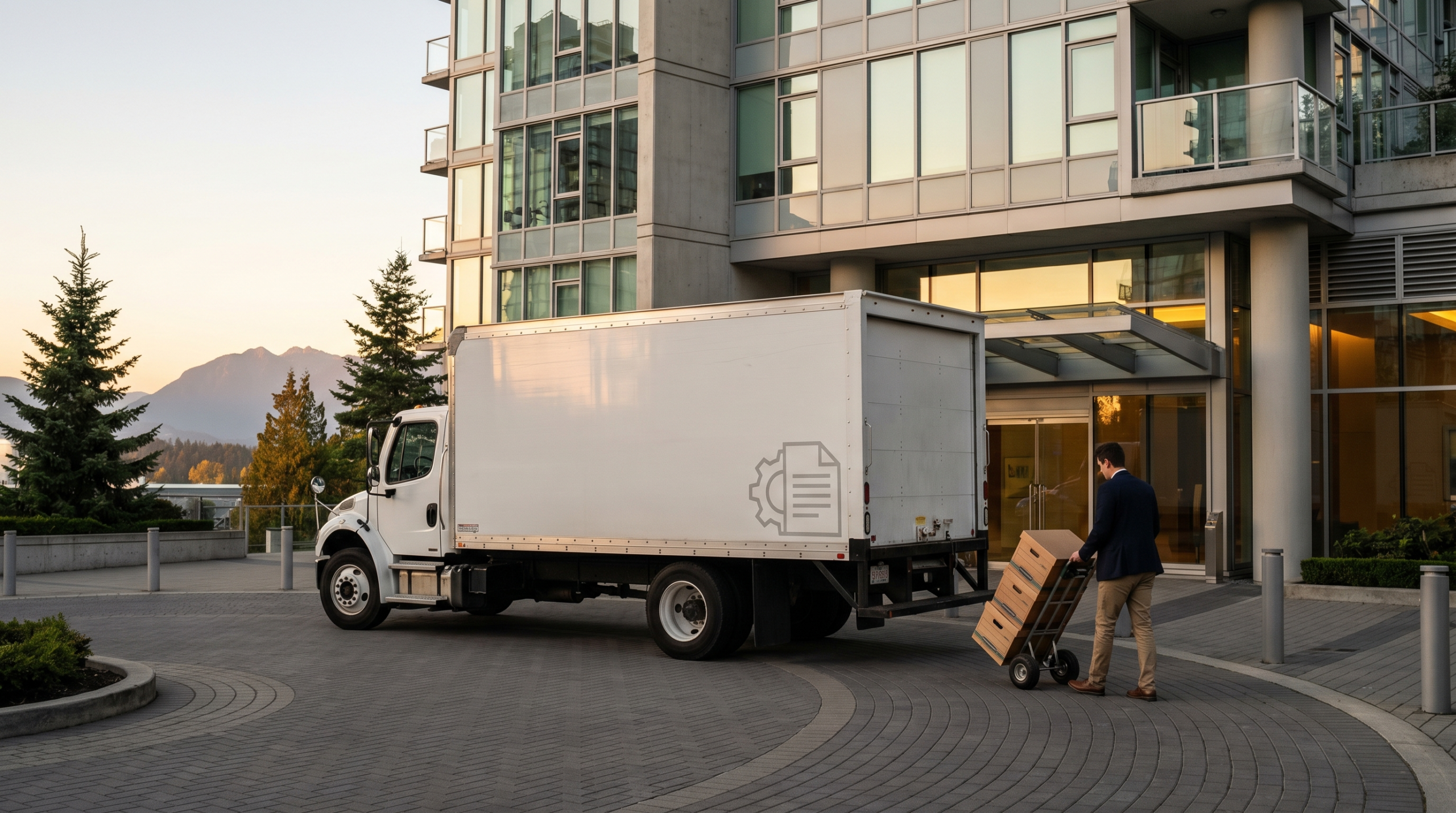
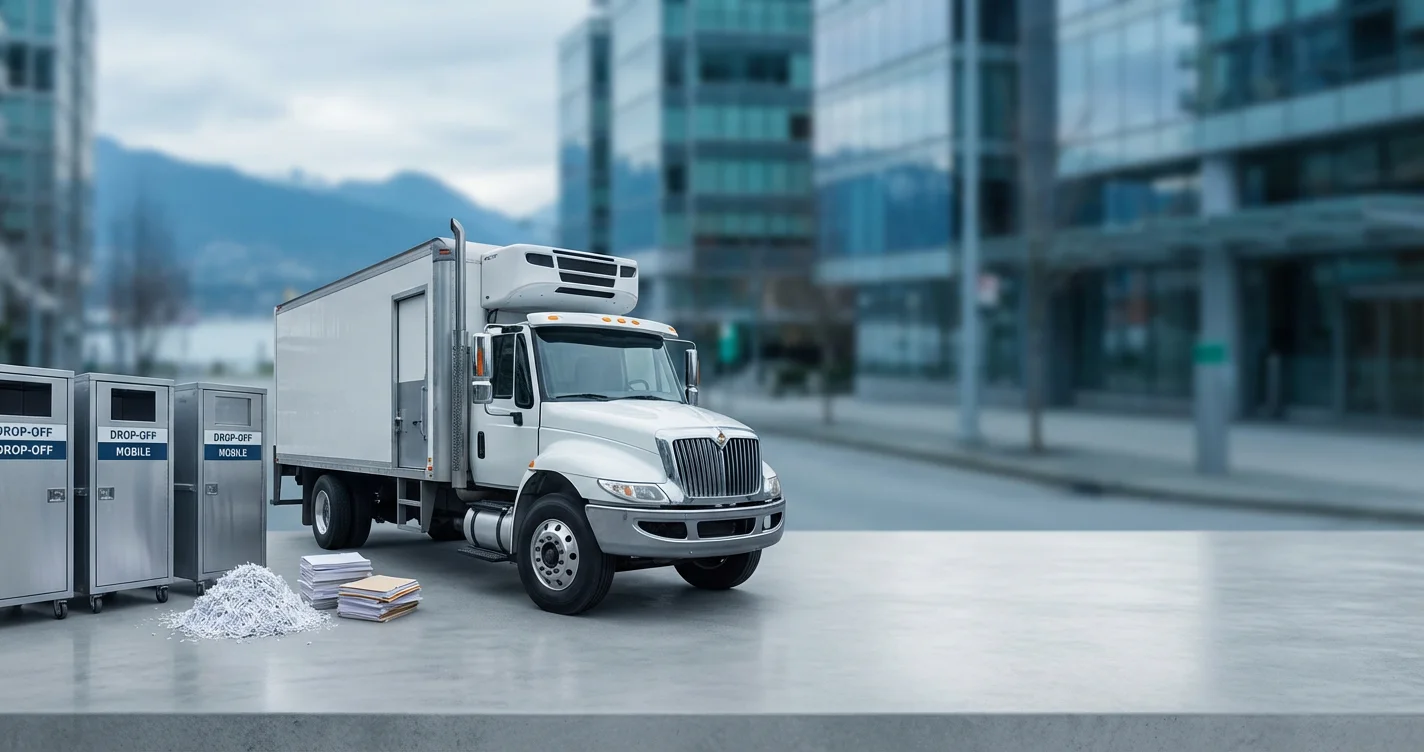
Mobile (on-site) shredding means a truck equipped with an industrial-grade shredder drives to your location. The driver loads your documents into the shredder on the truck, and everything is destroyed in your parking lot or driveway. You can watch the process on the truck’s closed-circuit monitor.
Drop-off shredding means you bring your documents to a retail location (like a UPS Store) or a shredding depot. You hand over the paper, it goes into a locked bin, and a shredding truck picks it up later.
The main difference is witnessing. With mobile shredding, you see your documents destroyed in real time. With drop-off, you trust the chain of custody between the drop-off point and the shredding truck’s arrival.
For businesses handling sensitive data, such as medical records, legal files, or financial documents, mobile shredding is generally the better choice. It eliminates the transport gap entirely.
For individuals with a small volume of personal documents, drop-off is convenient and affordable.
3. Is Professional Shredding Really Necessary, or Can I Use My Office Shredder?
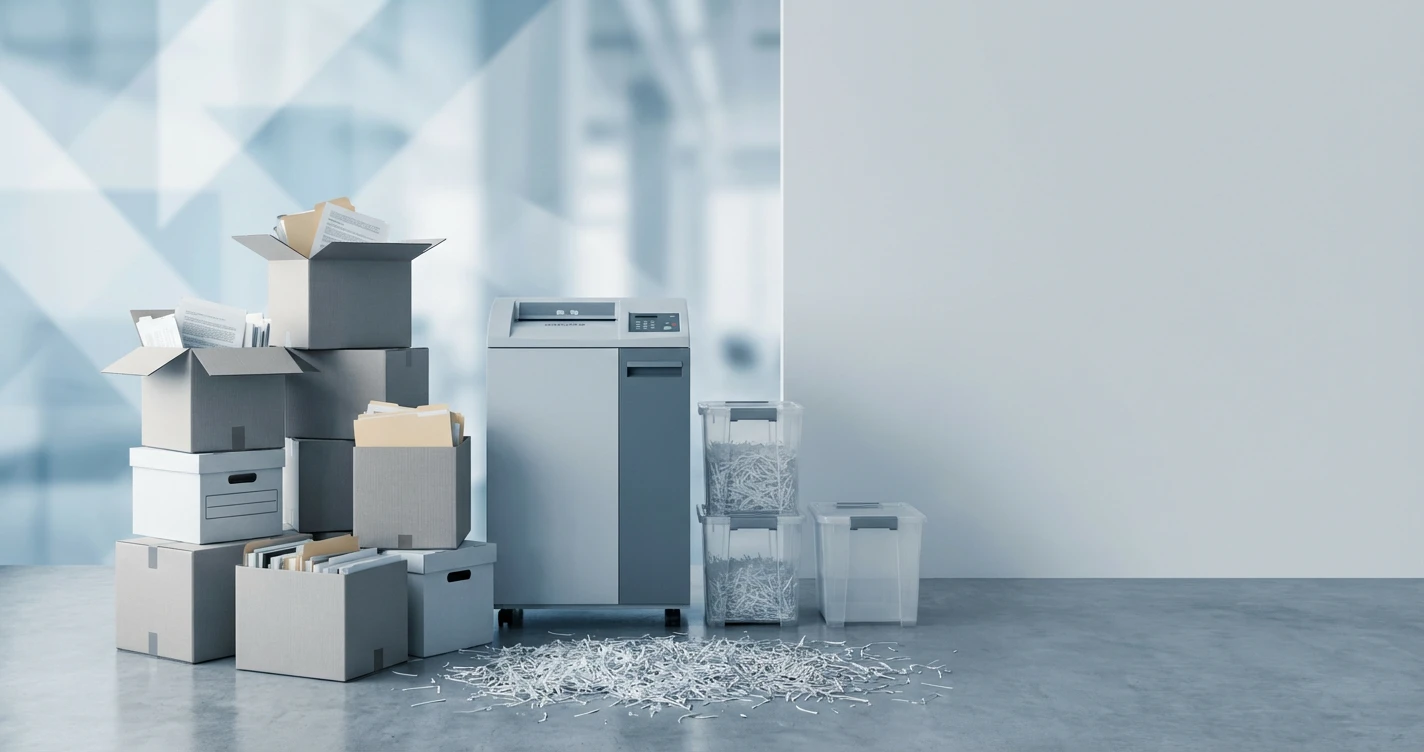
Office shredders work for occasional, low-volume use. A few sheets after a meeting, a credit card offer, a printout you no longer need. For that, a personal shredder is fine.
The problems start when you rely on an office shredder for actual compliance:
- Capacity. Most office shredders handle 10 to 15 sheets at a time and need cooldown periods after 15 to 30 minutes of continuous use. A single banker’s box contains roughly 2,500 sheets. That is hours of shredding with frequent pauses.
- Security level. Many office shredders are strip-cut, which produces long ribbons that can be reassembled. Professional shredders are cross-cut or micro-cut, producing particles that are practically impossible to reconstruct.
- No compliance documentation. Your office shredder does not issue a Certificate of Destruction. If the Privacy Commissioner or CRA audits your document disposal practices, you have no proof.
- Staff time. The time your employees spend feeding a shredder costs more than hiring a professional service. A mobile shredding truck can destroy 20 boxes in under 30 minutes.
For Vancouver businesses that produce more than one banker’s box of confidential paper per month, professional shredding is more secure, more efficient, and often less expensive than doing it in-house.
4. What Documents Should I Be Shredding?
Any document that contains personal, financial, or proprietary information should be shredded before disposal. This includes:
- Financial records: bank statements, credit card statements, tax returns past retention, invoices, receipts
- Employee records: pay stubs, performance reviews, benefits enrollment, SIN records
- Client/customer records: contact information, contracts, correspondence, purchase histories
- Medical records: patient files, lab results, insurance claims (for healthcare providers)
- Legal documents: expired contracts, case files past retention, privileged correspondence
- Corporate records: strategic plans, meeting minutes past retention, internal memos
- IT materials: printed passwords, access logs, system documentation
Under PIPEDA and BC’s PIPA, organizations are legally required to dispose of personal information securely once it is no longer needed for its original purpose. This is not optional for Vancouver businesses. It is the law.
If you are unsure what to shred and what to keep, INFOshred offers free consultations to help you establish a document retention and destruction policy.
5. How Do I Know if a Shredding Company Is Legitimate and Secure?
Not all shredding services in Vancouver operate at the same standard. Here is what to look for:
- Certificate of Destruction. Every job should come with one. If a provider does not offer this, move on.
- Locked containers. Secure bins should have tamper-proof locks. If your provider uses open bins or bags, that is a chain of custody gap.
- GPS-tracked vehicles. The truck transporting your documents should be tracked from pickup to destruction.
- Insurance and bonding. Ask whether the company carries liability insurance covering data breaches during transport.
- Consistent staff. Uniformed, background-checked drivers who show ID at every visit are a baseline expectation.
- Local reputation. Check Google reviews. INFOshred holds a 4.8 rating across 34 Google reviews from Vancouver-area clients.
- Recycling commitment. After destruction, material should go to a certified recycling facility, not a landfill.
A legitimate shredding company will answer all these questions openly. If they cannot, that is a red flag.
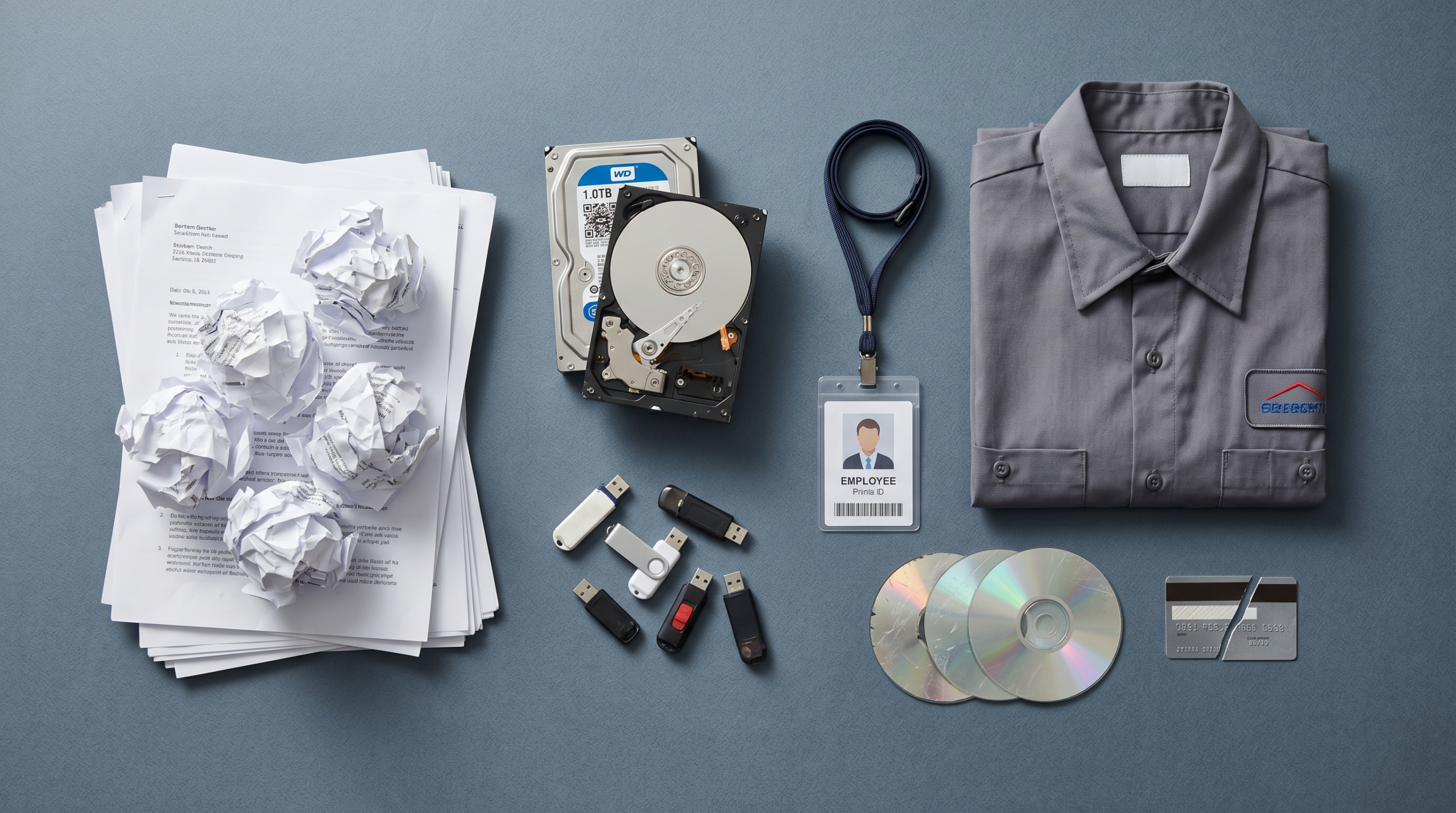
6. Can I Shred Hard Drives and Electronics, Not Just Paper?
Yes. Professional shredding services handle more than paper. Hard drive shredding is a growing service category because deleting files or reformatting a drive does not actually erase the data. Recovery software can retrieve “deleted” information from drives that have been wiped, formatted, or even physically damaged.
The only guaranteed method for destroying data on a hard drive is physical shredding. Industrial hard drive shredders reduce drives to small metal fragments, making data recovery impossible.
INFOshred handles:
- Hard disk drives (HDD)
- Solid state drives (SSD)
- USB drives and memory cards
- Backup tapes
- CDs, DVDs, and optical media
- Smartphones and tablets (case-by-case)
If your Vancouver office is upgrading computers, decommissioning servers, or clearing out old IT equipment, data destruction should be part of the process. You receive a Certificate of Destruction for electronic media, just as you would for paper.
7. How Often Should a Vancouver Business Schedule Shredding?
The answer depends on how much paper your business generates and the sensitivity of your industry.
| Business Type | Recommended Frequency | Why |
|---|---|---|
| Law firms | Weekly | High volume of privileged, confidential documents |
| Medical clinics | Weekly to bi-weekly | Patient records under strict PIPEDA/PIPA rules |
| Financial advisors | Bi-weekly | Client account info, transaction records |
| General offices | Monthly | Standard admin, HR, and correspondence files |
| Retail locations | Monthly | Customer payment info, employee records |
| Home offices | Quarterly or as needed | Personal tax docs, financial statements |
The key is to shred before paper piles up. Once you have boxes stacked in a closet or storage room, you have created a security liability. Locked shredding consoles placed in your office solve this by capturing documents at the point of disposal.
For a detailed guide on scheduling, see INFOshred’s article on how often Vancouver businesses should schedule document shredding.
Frequently Asked Questions
Do I need to sort or organize documents before shredding?
No. Professional shredders handle staples, paper clips, file folders, and even small binder rings. You do not need to remove bindings or sort by paper type. Just fill the bin or box and the shredding team handles the rest.
Is shredding environmentally friendly?
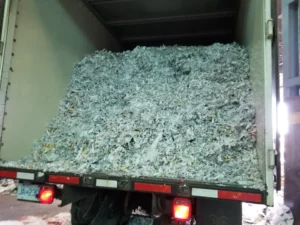
Yes. After secure destruction, shredded paper is baled and sent to a certified recycling facility. The material is pulped and turned into new paper products. Professional shredding is one of the few processes that is both a security measure and an environmental benefit.
Can I get a same-day or next-day shredding appointment in Vancouver?
In most cases, yes. Local providers like INFOshred can often accommodate urgent requests within one to two business days for locations across Metro Vancouver, from North Vancouver to Surrey to Maple Ridge. For same-day needs, call directly at (604) 716-9464.
Still have questions about shredding services in Vancouver? INFOshred has been providing secure, certified document destruction across the Lower Mainland for over 15 years. Every job includes a Certificate of Destruction, eco-friendly recycling, and service from a locally owned team that knows the area. Get a free estimate or call (604) 716-9464.