Table of Contents
- What Is the Difference Between Cross-Cut and Strip-Cut Shredding?
- How Strip-Cut Shredding Works — And Where It Falls Short
- What Cross-Cut Shredding Actually Does Differently
- Where Micro-Cut Fits In — And When You Need It
- Which Financial Documents Actually Require Higher-Security Shredding
- When a Home Shredder Isn’t Enough — Professional Document Shredding in Vancouver
Identity theft is one of the most common crimes reported to the Canadian Anti-Fraud Centre. Throwing out financial papers the wrong way makes it worse. Most people think any shredder will do the job. But the type of shredder you use matters a lot.
This article explains the difference between cross-cut and strip-cut shredding. It will help you decide if a home shredder is good enough — or if a professional financial document shredding service in Vancouver is the smarter choice for your sensitive records.
We will explain how each type works, how safe each one is, which papers are at risk, and when to call a professional.
What Is the Difference Between Cross-Cut and Strip-Cut Shredding?
Strip-cut shredders cut paper into long thin strips. They are fast, but the strips can be put back together. Cross-cut shredders cut paper two ways — up and down, and side to side. This makes small pieces that are much harder to rebuild. For most office papers, cross-cut is fine. But for financial records — like tax returns, bank statements, or anything with account numbers — micro-cut is the better choice. Micro-cut makes tiny confetti-like pieces. It meets DIN 66399 security level P-5 or higher. Most professional shredding services use this standard.
See professional financial document shredding in Vancouver →
How Strip-Cut Shredding Works — And Where It Falls Short
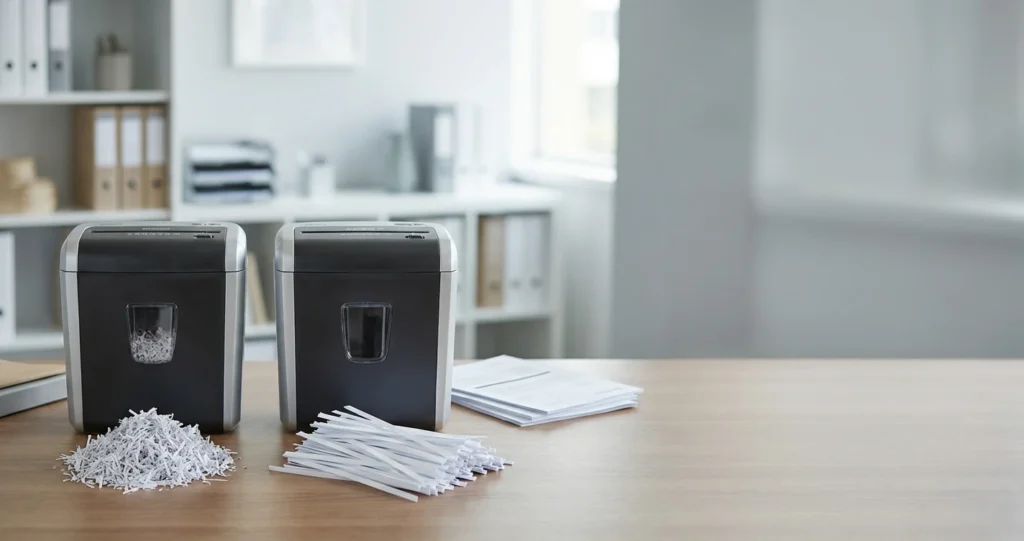
Strip-cut shredders push paper through one set of blades. The blades cut it into long strips. A typical strip is about 5–6mm wide. The strips can be as long as the full page.
These machines are fast. They can shred a lot of paper quickly. That is why people use them in home offices or mailrooms. But fast does not mean safe.
Where strip-cut falls short:
- The strips are long and easy to read
- With tape and time, someone could piece the strips back together
- Strip-cut shredders rank at DIN 66399 levels P-1 to P-2 — the lowest security levels
- They should not be used for personal, financial, medical, or legal papers
Where strip-cut is okay:
- Old flyers, newsletters, or rough drafts with no personal details
- Blank forms or packaging
If a paper has your name, account number, or date of birth on it — strip-cut is not safe enough.
What Cross-Cut Shredding Actually Does Differently
Cross-cut shredders use two sets of blades. One set cuts up and down. The other cuts side to side. This makes small rectangular or diamond-shaped pieces.
A cross-cut machine at DIN 66399 P-4 makes pieces up to 320mm² in size. In plain terms, one page becomes hundreds of small pieces instead of a few dozen long strips. It is much harder to put back together — but not impossible if someone has the right tools and enough time.
Strip-cut vs. cross-cut at a glance:
| Feature | Strip-Cut (P-1/P-2) | Cross-Cut (P-3/P-4) |
| Particle shape | Long ribbons | Small rectangles |
| Pieces per page | Dozens | Hundreds |
| Reconstruction risk | High | Low to moderate |
| Speed | Fast | Moderate |
| Best use case | Non-sensitive documents | Sensitive personal records |
Cross-cut is the least we would suggest for any paper that has both a name and an account number on it. That covers most of the financial papers in your home office right now.
Where Micro-Cut Fits In — And When You Need It
Micro-cut shredding goes one step further than cross-cut. It makes tiny confetti-sized pieces — about 2mm x 15mm or smaller, depending on the machine.
Under DIN 66399, micro-cut starts at the P-5 security level. At P-5, one page becomes hundreds to thousands of tiny pieces, depending on the model. It is seen as nearly impossible to put back together without special equipment.
All three shredder types compared:
| Feature | Strip-Cut | Cross-Cut | Micro-Cut |
| DIN 66399 level | P-1 to P-2 | P-3 to P-4 | P-5 and above |
| Particle size | Up to 800mm² (P-2) | Up to 320mm² (P-4) | 30mm² or smaller (P-5) |
| Reconstruction risk | High | Low to moderate | Practically impossible |
| Best for | General waste | Sensitive records | Financial, legal, medical documents |
You can buy a home micro-cut shredder. But they jam more often, need more care, and are slower than basic models. Professional shredding equipment is far more powerful — and can handle large amounts of paper at once.
Have a backlog of financial records to clear? Get a free shredding quote in Vancouver →
Which Financial Documents Actually Require Higher-Security Shredding
Knowing the security levels is a good start. But knowing which of your own papers need that level of protection is what really counts.
These documents have enough personal detail that they need cross-cut or micro-cut shredding at a minimum:
- T1 tax returns, T4 slips, and Notices of Assessment — these list your Social Insurance Number, income, and employer details
- Bank and investment statements — these show account numbers, balances, and transaction history
- Pay stubs — these include your employer name, salary, and deductions
- Credit card statements and loan documents — these show credit limits, payment history, and lender details
- Business financial records — these carry extra risk; rules under PIPEDA and BC PIPA say personal information must be destroyed safely when it is no longer needed
We have seen Vancouver businesses keep years of paper statements with no plan to destroy them. One privacy incident changes everything — fast.
When you shred any of the papers above, cross-cut is the bare minimum. For anything with a SIN, account number, or medical details, micro-cut or professional shredding is the right call.
When a Home Shredder Isn’t Enough — Professional Document Shredding in Vancouver
A home shredder handles a few pages at a time. It jams, overheats, and needs you to sort papers by hand. For one tax return, that is fine. For years of old financial records, it becomes a big job.
Here is how a home shredder compares to a professional service:
| Factor | Home Shredder | Professional Service |
| Security level | P-3 to P-4 at best | P-5 and above |
| Volume capacity | Low — jams frequently | High — handles bulk efficiently |
| Chain of custody | None | Certificate of destruction provided |
| Compliance documentation | No | Yes — required under PIPEDA and BC PIPA |
| Convenience | Requires sorting and manual feeding | Bins picked up or shredded on-site |
A certificate of destruction is more important than most people think. If your Vancouver business falls under PIPEDA or BC PIPA, you need written proof that your records were destroyed. This is a legal requirement, not just good practice. The Office of the Privacy Commissioner of Canada says that even if you hire a shredding company, your business is still on the hook for making sure the job is done right.
When we handle a document shred for a client, every bin is sealed on-site before the truck leaves. Shredding happens in a watched environment. A certificate of destruction is given the same day. You get top-level security with the paperwork to prove it.
We offer ongoing service for businesses and one-time shredding for home clients clearing out old records.
Schedule your document shredding in Vancouver →
Frequently Asked Questions
Is cross-cut shredding safe enough for bank statements? Cross-cut shredding gives good protection for most personal papers. For bank statements — which have account numbers, balances, and transaction history — micro-cut or professional shredding is the safer choice. Cross-cut makes pieces up to 320mm² in size. That is harder to rebuild than strip-cut ribbons, but still possible with enough effort and time.
What shredder type do professional services use? Professional shredding services use heavy-duty equipment at DIN 66399 P-5 and above — the micro-cut range. This is far beyond what most home or office shredders can do. It also comes with a chain of custody record.
How long should I keep financial documents before shredding? It depends on the type of record and whether you are a business or a person. The Canada Revenue Agency says to keep personal tax records for at least six years. Business records may need to be kept longer. Once the time is up, you are required to destroy them safely — it is not optional.
INFOshred provides mobile, on-site document shredding for businesses and residents across Vancouver and the Greater Vancouver area. All shredding is performed on-site with a certificate of destruction issued upon completion.