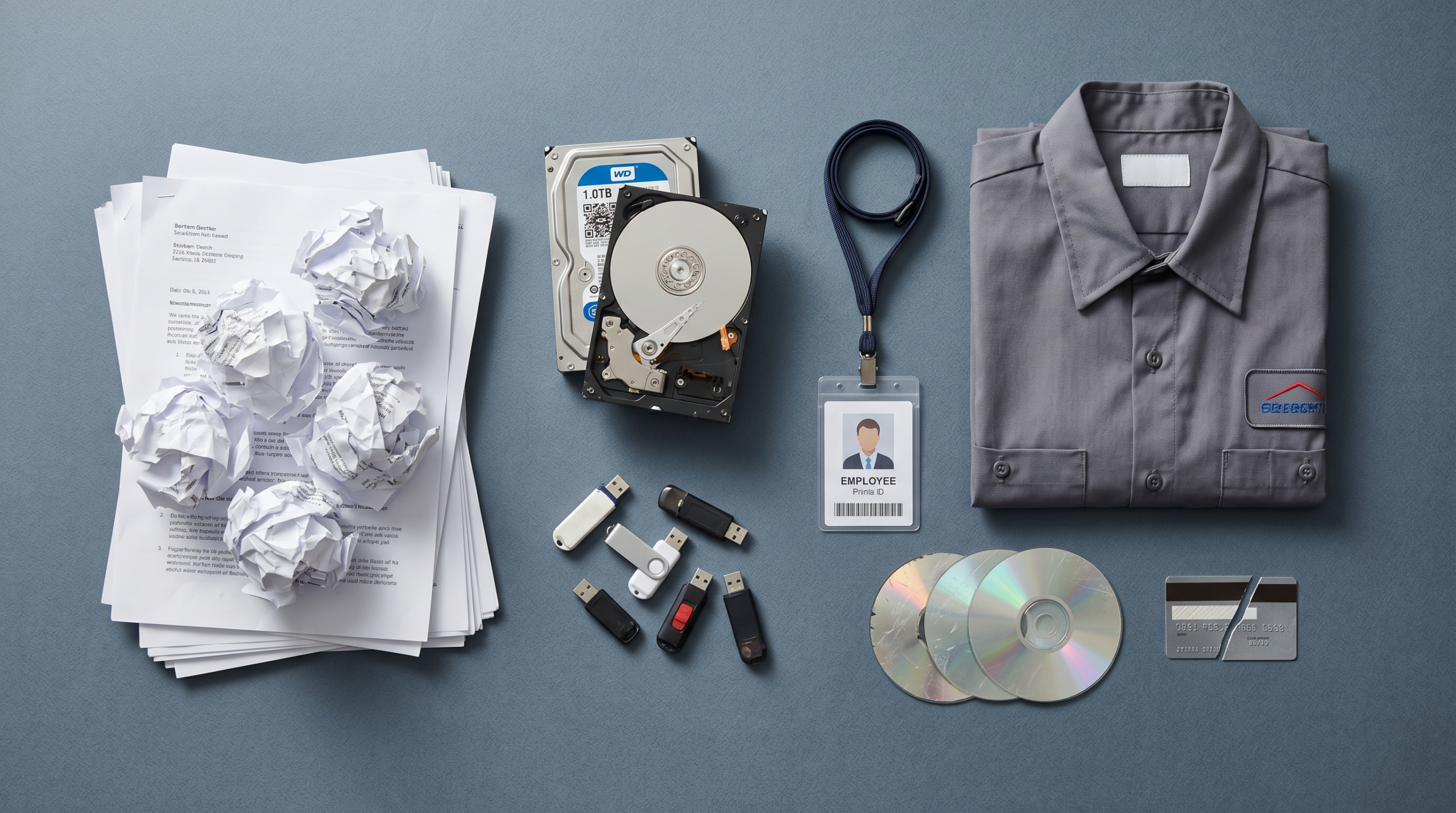
Vancouver businesses collect many sensitive documents. These include client files, HR records, financial statements, and contracts. When you need to get rid of old records, you can’t just throw them in the recycling bin. Using your office shredder isn’t safe either. These methods create serious privacy risks. They can also break PIPEDA laws.
One poorly disposed employee file or client contract can cost you $100,000 in fines. This is according to Canadian privacy laws. For Vancouver businesses with sensitive records (from law firms in Coal Harbour to medical clinics in Kitsilano), secure destruction isn’t just smart. It’s required by law.
This guide shows you how to properly destroy sensitive business records in Vancouver. It covers BC compliance rules, certified destruction methods, and when to use professional services.
You’ll learn what counts as sensitive information under Canadian law. You’ll discover the five approved ways to destroy documents. You’ll understand how to choose between mobile and off-site shredding in the Lower Mainland. You’ll also learn what certifications matter when picking a Vancouver destruction provider.
How Should You Dispose of Sensitive Documents in Vancouver?
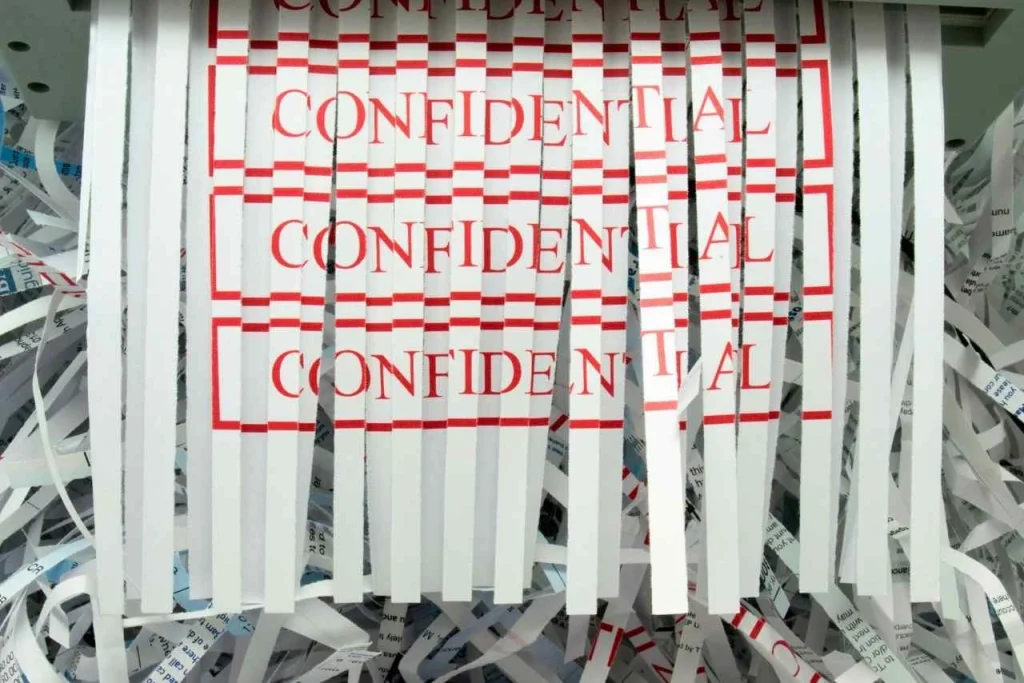
To properly dispose of sensitive documents in Vancouver, businesses should use certified cross-cut shredding. This means security level P-4 or higher. You can also use professional destruction services. These services provide chain of custody documentation. Under PIPEDA and BC privacy laws, you can use these destruction methods:
• Cross-cut or micro-cut shredding for paper documents
• Degaussing or physical destruction for hard drives and electronic media
• Pulping or incineration for bulk records
• Secure erasure software (NIST-approved) for digital files
Never use regular recycling bins, basic strip-cut shredders, or burn sensitive documents yourself. Most Vancouver businesses choose mobile shredding services. These services destroy documents on-site. You can watch the destruction happen. They provide certificates of destruction for compliance audits.
Learn more about professional paper shredding in Vancouver
What Counts as Sensitive Business Records Under Canadian Law
Before you can destroy records properly, you need to know which documents need secure destruction under Canadian law.
Under PIPEDA (Personal Information Protection and Electronic Documents Act), sensitive business records include any documents with personal information. Personal information means any facts about a person you can identify. This includes a person’s name plus details like their address, phone number, email, financial details, medical information, or work history.
The Office of the Privacy Commissioner of Canada provides guidance that says organizations must create guidelines for destroying personal information. You must use care during disposal to prevent unauthorized access.
Sensitive documents vary by industry:
Legal practices must secure files with client details, retainer agreements, correspondence, court documents, trust account records, and conflict check databases. The Law Society of BC requires lawyers to keep financial records for 10 years. Client file retention periods vary based on practice area and limitation periods.
Healthcare and medical offices handle patient charts, diagnostic reports, prescription records, insurance claims, consent forms, and billing information. These fall under BC’s Personal Information Protection Act (BC PIPA) in addition to PIPEDA.
Financial services and accounting firms manage tax returns, financial statements, investment portfolios, credit applications, banking records, and payroll information. FINTRAC (Financial Transactions and Reports Analysis Centre of Canada) requires additional record-keeping and destruction rules.
General businesses across Vancouver collect employee files with SIN numbers, HR records, client contracts, vendor agreements, customer databases, and internal communications with personal details.
Record retention periods in BC typically require businesses to keep tax-related documents for six years from the end of the tax year.<sup>1</sup> Employment records must be kept for different periods depending on the type of record. Business incorporation documents have different requirements under the BC Business Corporations Act.
If you dispose of records improperly, the Office of the Privacy Commissioner of Canada may investigate. The Commissioner can order you to change practices, publish notices of violation, and recommend prosecution. Courts can fine you up to $100,000 for PIPEDA violations. You may also face reputation damage, loss of client trust, and civil lawsuits from affected individuals.
Most Vancouver businesses don’t know if client emails count as sensitive. They do if they contain identifiable information paired with any business detail.
The 5 Approved Methods for Destroying Sensitive Business Records
Now you understand what needs secure destruction. Here are the approved methods recognized under Canadian privacy law.
Cross-Cut Shredding
Cross-cut shredding cuts paper into small pieces using perpendicular cuts. Security levels follow the ISO/IEC 21964 international standard (formerly DIN 66399). P-3 level produces particles of about 320mm² and provides minimum security for confidential documents. P-4 level (particles of 160mm² or less) is recommended for sensitive business records. P-5 level and higher (particles of 30mm² or less) is for top-secret information.
Most Vancouver businesses use P-4 level shredding for client files, employee records, and financial documents. This provides strong protection against document reconstruction while keeping costs reasonable.
Pulping
Pulping dissolves paper into slurry using water and chemicals. This method works well for large-volume destruction. Examples include office tower cleanouts or legal firm archive purges. Vancouver businesses use pulping when disposing of entire filing systems during office moves or business closures. The process ensures complete fiber separation. This makes document reconstruction impossible.
Incineration
Incineration burns documents to ash in controlled facilities. While effective, air quality and environmental considerations in Metro Vancouver make other methods more common. Businesses rarely choose incineration because more environmentally responsible methods are available. When used, it works for specialized documents like security credentials or proprietary formulas that need complete material elimination.
Degaussing and Physical Destruction
Electronic media (hard drives, USB drives, CDs, backup tapes) need specialized destruction. File deletion doesn’t remove data. Degaussing uses powerful magnets to disrupt magnetic fields on storage devices. Physical destruction crushes, shreds, or punctures devices to make them unreadable.
Simple file deletion or formatting leaves data recoverable with forensic tools. Vancouver businesses handling electronic records need certified electronic media destruction following NIST Special Publication 800-88 guidelines.
Secure Digital Erasure
Software-based destruction overwrites data multiple times using approved algorithms. This method requires verification that erasure completed successfully. The National Institute of Standards and Technology (NIST) provides approved sanitization methods. Digital erasure works for situations where you’re repurposing or donating equipment rather than physically destroying it.
Destruction Method Comparison
| Destruction Method | Security Level | Best For | Compliance Rating | Relative Cost |
| Cross-cut shredding (P-4) | High | Paper records, daily operations | PIPEDA compliant | $$ |
| Pulping | Very High | Large volume purges | PIPEDA compliant | $$$ |
| Incineration | Very High | Specialized sensitive materials | PIPEDA compliant | $$$$ |
| Degaussing/Physical destruction | Very High | Electronic media, hard drives | NIST/PIPEDA compliant | $$$ |
| Secure digital erasure | Medium-High | Reusable electronic devices | NIST approved | $ |
Professional Shredding vs. Office Shredders: What Vancouver Businesses Need to Know
Now you understand the approved destruction methods. The question becomes: should you handle this in-house or hire a Vancouver professional?
Why Office Shredders Don’t Work for Sensitive Records
Standard office shredders typically provide P-2 or P-3 security levels. This is not enough for confidential business records. Strip-cut shredders (straight cuts) create long strips. These are easily reassembled using basic document reconstruction techniques. Even cross-cut office shredders jam frequently when handling stapled documents. This leaves readable fragments in the waste bin.
Office shredders provide no chain of custody documentation. During compliance audits or Privacy Commissioner investigations, you cannot prove proper destruction occurred. Staff time spent feeding documents through desk shredders costs more than businesses realize. An employee earning $25 per hour spending 8 hours shredding equals $200 in labor costs alone.
Volume Thresholds: When to Switch
If your Vancouver business generates more than one banker’s box of sensitive documents monthly, professional shredding becomes cost-effective. For occasional purges exceeding five boxes annually, the time savings and compliance documentation justify professional service.
Calculate your actual cost: office shredder purchase ($300-800), maintenance ($100 or more annually), staff time (15-20 minutes per box), and jam-related frustration. Professional shredding typically costs $8-15 per banker’s box with certificate of destruction included.
Mobile Shredding in Vancouver
Mobile shredding brings an industrial shredding truck to your location. The truck parks at your building. This is common throughout downtown Vancouver, Burnaby, Richmond, and Surrey. You witness documents fed into the truck-mounted shredder in real-time. The service provides immediate certificate of destruction before leaving your premises.
Mobile shredding offers maximum security because documents never leave your sight. This matters for law firms, medical offices, and financial advisors handling highly sensitive client information. Professional secure document destruction services complete the process quickly. Most Vancouver clients are surprised that witnessed mobile shredding takes 10-15 minutes for 10 boxes. This is much faster than feeding an office shredder for days.
Off-Site (Plant-Based) Shredding
Off-site shredding uses secure, locked containers placed at your Vancouver location. The service provider collects containers on scheduled routes. These can be weekly, biweekly, or monthly. Documents are transported to a secure facility where destruction occurs with full chain of custody tracking.
Off-site programs work for businesses generating consistent document volumes. Containers accept documents continuously without scheduling individual pickups. You receive certificates of destruction after each scheduled service. This method costs less than mobile shredding while maintaining security through locked containers and manifested tracking.
Shredding Approach Comparison
| Approach | Security | Convenience | Cost | Best For | Chain of Custody |
| Office shredder | Low (P-2 to P-3) | Low (jams, time) | Medium | Less than 5 boxes per year | None |
| Mobile shredding | Very High (P-4 or higher) | Very High (witnessed) | High | One-time purges, high sensitivity | Complete with certificate |
| Off-site program | High (P-4 or higher) | High (scheduled) | Medium | Regular volume, ongoing needs | Complete with certificate |
Get certified paper shredding in Vancouver
How to Choose a Certified Document Destruction Provider in Vancouver
Once you’ve decided professional service makes sense, here’s how to select a trustworthy Vancouver provider.
Essential Certifications
NAID AAA Certification represents the gold standard for document destruction. The National Association for Information Destruction conducts unannounced audits. These verify security procedures, employee screening, operational processes, and equipment standards. Only providers meeting all requirements receive AAA certification.
ISO 9001 certification shows quality management systems. Bonded and insured providers protect you financially if security breaches occur. Verify these credentials directly. Ask for certificate copies.
Chain of Custody Requirements
Chain of custody means documented tracking from the moment documents enter a locked container until destruction completion. Proper chain of custody includes:
• Locked containers preventing unauthorized access at your location
• Detailed manifests recording date, time, and number of containers collected
• Vehicle tracking during transportation
• Witness signatures at destruction
• Itemized documentation of materials destroyed
Without complete chain of custody, you cannot prove compliance during audits or investigations.
Certificate of Destruction Requirements
Every destruction service should provide a certificate. This includes destruction date, method used (cross-cut shredding with security level), weight or volume destroyed, witness signatures, and your company name. This certificate serves as legal proof of proper disposal.
Good providers keep digital copies indefinitely. During compliance audits, Vancouver businesses often need destruction certificates from previous years. Reliable providers store these so clients can retrieve them instantly.
Red Flags to Avoid
Walk away from providers who:
• Cannot show insurance, bonding or staff screening
• Refuse to provide certificates of destruction
• Won’t allow witnessed destruction (for mobile services)
• Offer prices far below market rates ($4-5 per box suggests corners being cut)
• Use employees without security screening
• Cannot explain their chain of custody process
Questions to Ask Vancouver Providers:
• Are your employees background-screened, bonded and insured? (Ask for proof)
• What security level do you shred to? (Should be P-4 minimum)
• Do you provide certificates of destruction? (Should be standard, not extra charge)
• Can I witness the destruction? (Yes for mobile services)
• What areas do you service? (Should cover Downtown Vancouver, North Vancouver, Burnaby, Richmond, Surrey, Langley, and Fraser Valley)
• What’s your typical response time? (Should be 24-48 hours for quotes, 48-72 hours for service)
• Do you destroy hard drives and electronic media? (Important for complete data destruction)
• Are your employees bonded and security-screened? (Should be yes)
Local Advantage
Vancouver-based providers understand BC privacy regulations. These include PIPEDA, BC PIPA, and industry-specific requirements. They respond faster for compliance deadlines and urgent purges. Supporting Lower Mainland businesses keeps your money in the local economy. It also ensures service providers understand regional business needs.
The Secure Destruction Process: What to Expect When Working with Vancouver Shredding Services
Once you’ve identified a certified provider that meets these criteria, here’s exactly what the destruction process looks like from first contact to final certificate.
Step 1: Initial Contact and Needs Assessment
Contact the provider by phone or online form. They’ll ask about your document volume (estimated number of banker’s boxes or filing cabinets), frequency needs (one-time purge or recurring service), and material types (paper only or including hard drives, CDs, other media).
For Vancouver businesses, mention your location and access considerations. Are you in a high-rise requiring elevator scheduling? Ground-level access with loading dock? Parking restrictions in busy areas like Downtown or Kitsilano? This information helps providers plan efficient service.
Step 2: Container Placement or Pickup Scheduling
For ongoing programs, the provider delivers locked security consoles to your office. These range from small desk-side containers to large rolling bins depending on your volume. Containers stay at your location where staff deposit documents continuously.
For one-time purges, schedule a specific date and time for mobile truck service or container pickup. Most Vancouver providers offer flexible scheduling. This includes evening and weekend appointments for businesses that cannot disrupt regular hours.
Step 3: Secure Collection with Chain of Custody
On collection day, the service provider arrives with manifest documentation. For off-site service, they load your containers onto trucks with GPS tracking. For mobile service, the shredding truck parks at your location.
Containers remain locked during transportation. The manifest records date, time, number of containers, and your business information. This documentation begins your chain of custody trail.
Step 4: Destruction Execution
Mobile shredding happens at your premises. You can watch documents feed into the industrial shredder. The truck-mounted equipment shreds at P-4 or P-5 security levels. This produces confetti-sized particles. The entire load processes in minutes. Typical Vancouver office purges of 10-20 boxes complete in 15-30 minutes.
Off-site destruction occurs at secure facilities. Your containers are emptied and contents shredded using industrial equipment. Facilities have security cameras, restricted access, and controlled environments.
Step 5: Certificate Issuance and Storage
Mobile services provide certificates immediately upon completion. Off-site services issue certificates within 24-48 hours. The certificate documents everything destroyed and serves as your compliance record.
Keep certificates with your business records. During Privacy Commissioner audits, CRA tax audits, or industry compliance reviews, these prove proper destruction. Digital copies ensure you never lose proof of destruction.
Ongoing Programs for Vancouver Businesses
Law firms typically use weekly or biweekly pickups due to constant document generation. Medical offices and dental clinics often schedule monthly service. Financial advisors and accounting firms increase frequency during tax season. They reduce to quarterly during slower periods.
Most Vancouver providers accommodate schedule changes without penalties. Need to skip a month? Going on vacation? Good services adjust schedules to match your actual needs.
Typical Timelines
Request a quote and expect response within 24 hours on business days. Vancouver providers operating in competitive markets respond quickly to inquiries. Standard service scheduling occurs within 48-72 hours of approval. Emergency same-day service costs more but handles urgent compliance situations or unexpected audits.
Cost Guide: Document Destruction Pricing in Vancouver (2025)
Understanding pricing helps you budget properly. It also helps you identify fair market rates versus inflated costs or suspiciously low bids.
One-Time Purge Pricing
Vancouver providers typically charge per banker’s box. This is a standard file box, approximately 12 inches by 15 inches by 10 inches. Metro Vancouver rates generally range from $8-15 per box depending on provider, volume, and location.
Expect minimum charges for small jobs. A minimum of $75-150 covers the provider’s time and transportation costs. Volume discounts typically apply to larger purges. Rates often drop to $6-10 per box for high-volume jobs.
Larger purges (100 or more boxes) often receive custom pricing. Office cleanouts, business closures, or legal firm archive disposals qualify for project rates significantly below per-box pricing.
Scheduled Service Pricing
Monthly container service in Vancouver typically costs:
• Small business (5-20 employees): $30-60 per month for console service
• Medium business (20-100 employees): $60-150 per month for multiple consoles or larger containers
• Large business (100 or more employees): Custom programs starting at $150 or more per month with multiple collection points
Prices include container rental, scheduled pickup, shredding, and certificates of destruction. Frequency (weekly versus monthly) affects pricing. More frequent service costs more.
Hard Drive Destruction Pricing
Electronic media destruction is priced separately from paper shredding. Typical Vancouver rates:
• Hard drives: $10-20 per drive
• USB drives or flash media: $5-10 per device
• CDs or DVDs: $1-2 per disc (bulk rates)
• Backup tapes: $5-10 per tape
Physical destruction (crushing or shredding) costs more than degaussing because it provides higher security. Some providers offer witnessed hard drive destruction for sensitive business needs.
Mobile vs. Off-Site Cost Difference
Mobile shredding typically costs more than off-site service for equivalent volumes. A 10-box purge might cost $120 mobile versus $90 off-site. The premium pays for convenience, witnessed destruction, and immediate certificate issuance.
For businesses handling extremely sensitive information (legal case files, medical records, financial planning documents), the mobile premium provides peace of mind worth the additional cost.
Vancouver Pricing Factors
Your location affects pricing. Downtown Vancouver, Coal Harbour, Yaletown, and other central areas may carry slight premiums. This is due to parking challenges and access restrictions. Suburban locations like Surrey, Langley, Abbotsford, or Mission often receive slightly lower rates.
Building access matters. Ground-level offices with loading zones simplify collection. High-rise buildings requiring elevator scheduling, weekend access, or security escort add complexity and cost. Discuss access during initial quotes to avoid surprise charges.
Volume and frequency create economies of scale. Regular customers receive better per-unit pricing than occasional users. Annual commitments often provide discounts versus month-to-month service.
Hidden Costs to Avoid
Watch for providers who quote low base rates but add:
• Fuel surcharges not disclosed upfront
• Container rental fees charged separately
• “Retrieval fees” if you cancel service and they collect their containers
• Per-page charges instead of per-box rates (inflates costs significantly)
• Mandatory contract terms with early termination penalties
Good Vancouver providers include all costs in their quoted rates. The price you hear should be the price you pay.
Vancouver Document Destruction Pricing Summary
| Service Type | Vancouver Price Range | What’s Included | Best For |
| One-time purge (mobile) | $10-15 per box (minimum $100-150) | Witnessed destruction, immediate certificate | Office cleanouts, urgent compliance |
| One-time purge (off-site) | $8-12 per box (minimum $75-100) | Secure transport, destruction, certificate | Regular purges, cost-sensitive |
| Monthly program (small) | $30-60 per month | Console, monthly pickup, certificates | 5-20 employees, light volume |
| Monthly program (medium) | $60-150 per month | Multiple consoles, flexible scheduling | 20-100 employees, regular volume |
| Hard drive destruction | $10-20 per drive | Physical destruction or degaussing | Electronic media, IT equipment disposal |
| Emergency same-day | Premium rates | Immediate response, flexible timing | Compliance deadlines, urgent audits |
Schedule Secure Destruction Service in Vancouver
Proper destruction of sensitive business records protects your Vancouver business from PIPEDA violations. It safeguards client trust and frees valuable office space. Whether you need one-time purge service or ongoing document management, certified professional shredding provides security, compliance documentation, and peace of mind.
Look for providers offering P-4 or higher security levels. Make sure they offer complete chain of custody tracking and certificates of destruction. Expect transparent pricing between $8-15 per box for one-time service or $30-150 monthly for scheduled programs depending on your business size.
Same-week availability, certified process, and transparent pricing make professional shredding the smart choice for BC businesses handling sensitive information.
Sources and References
PIPEDA penalties and enforcement: Office of the Privacy Commissioner of Canada
Document shredder security levels (P-3, P-4, P-5): ISO/IEC 21964 international standard
NAID AAA Certification standards: National Association for Information Destruction
Business record retention requirements: Canada Revenue Agency business records guidance and BC Business Corporations Act
Electronic media destruction guidelines: NIST Special Publication 800-88, Guidelines for Media Sanitization
PIPEDA personal information definitions: Personal Information Protection and Electronic Documents Act, Section 2
BC privacy law: Personal Information Protection Act (BC PIPA)
Personal information retention and disposal: Office of the Privacy Commissioner of Canada
References
Canada Revenue Agency. “Where to keep your records, for how long and how to request the permission to destroy them early.” Government of Canada.